
WebSockets vs Webhooks: Push Data the Right Way
Backend ·
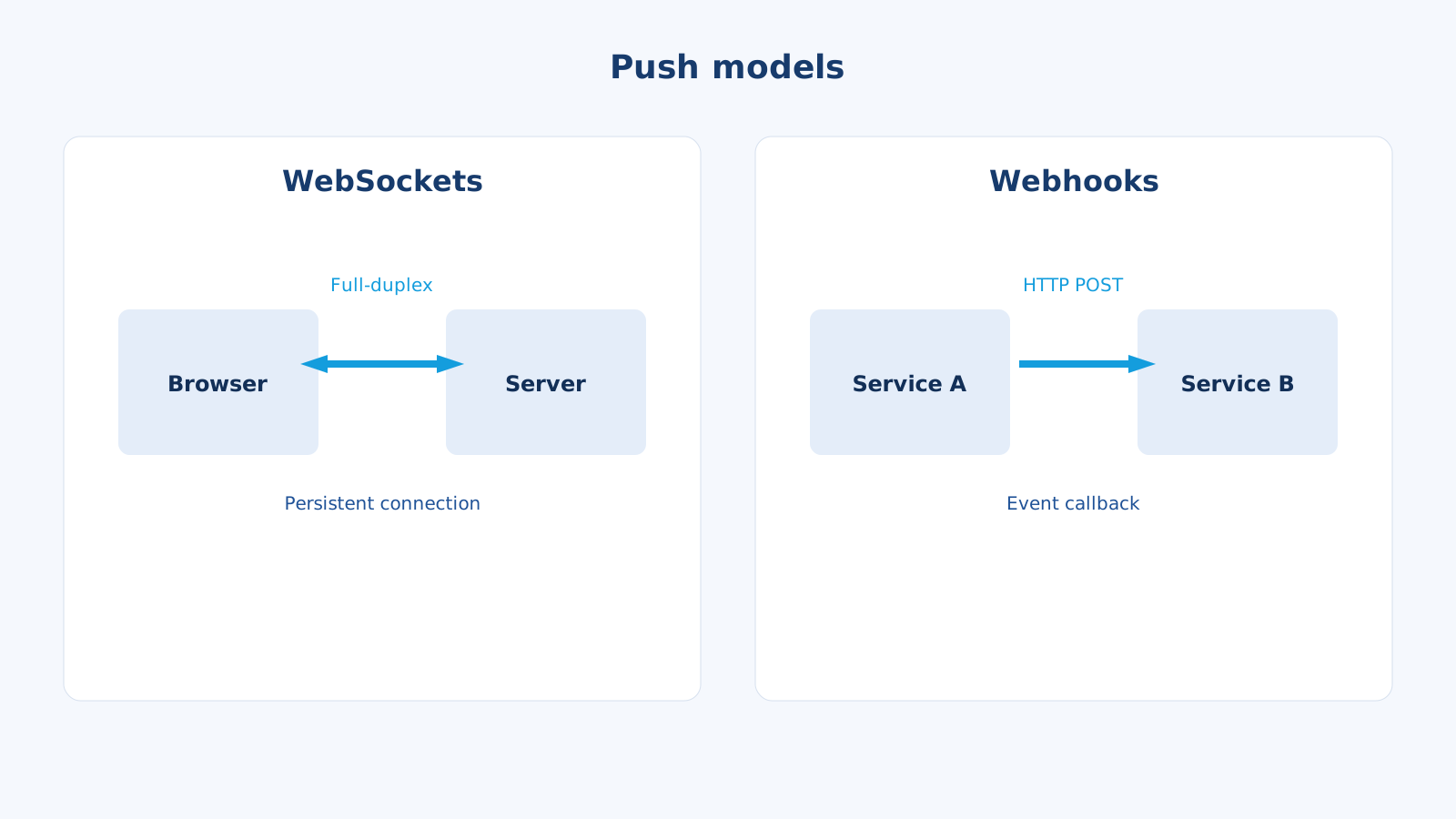
Both tools “push” events. That is where the similarity ends. A WebSocket is a long-lived, full-duplex connection. A webhook is a normal HTTP request your system sends (or receives) when something happens. If you treat them as interchangeable, you will overbuild a chat stack for a Stripe event, or you will poll a webhook inbox trying to animate a live map.
I use this rule: if the browser or a connected client must see state change in the next 100ms, start with WebSockets. If another server must react to a business event, start with webhooks.
What each one actually is
WebSockets
The client opens an HTTP request, then upgrades it (101 Switching Protocols). After that, either side can send frames at any time. There is no request/response pairing unless you invent it.
That gives you:
- Low latency
- Server-to-client and client-to-server messages
- Presence (“user is online”)
- Less HTTP overhead than polling every second
It also gives you operational pain: sticky sessions, idle timeouts, reconnect storms, and a process that must stay in memory holding sockets.
Webhooks
A webhook is “HTTP as an event bus.” Provider A POSTs JSON to a URL you own. You verify a signature, persist the event, and return 2xx quickly.
That gives you:
- Loose coupling between systems
- No open connection to maintain
- Easy retries, dead-letter queues, and audit logs
- A model every backend already knows: receive HTTP, write to DB, enqueue work
It is at-least-once in the real world. Timeouts, retries, and “I got 200 but crashed after” are normal. Design for duplicates.
A concrete example from a product I would actually ship
Imagine a support inbox that talks to WhatsApp and also shows agents a live board.
- Meta/WhatsApp -> your API is a webhook. WhatsApp will not hold a socket to your Laravel box. It POSTs
messagestohttps://api.yourapp.com/webhooks/whatsapp. You verifyX-Hub-Signature-256, store the payload, enqueueProcessWhatsAppMessage, and return200in under a second. - Your API -> the agent UI is a WebSocket. The agent has the inbox open. When the job finishes, you publish
conversation.updatedon a channel likeinbox.{agentId}. The browser paints the new bubble without refresh. - Your API -> billing is a webhook again. If Finance runs a separate service, POST
conversation.closedto their URL. Do not open a socket into another team’s VPC unless you enjoy on-call.
Same product, three pushes, two tools. That mix is the point.
Payments look the same. Stripe payment_intent.succeeded is a webhook. The checkout page waiting for “Payment confirmed” can be a short poll, a webhook-driven redirect, or a WebSocket/SSE push. I almost never WebSocket Stripe itself.
Side-by-side
| WebSockets | Webhooks | |
|---|---|---|
| Direction | Both ways, while connected | One HTTP call per event |
| Transport | Persistent TCP after upgrade | Stateless HTTP |
| Typical client | Browser, mobile app, game client | Another server |
| Delivery | Best-effort while connected; you handle replay | Provider retries; you make it idempotent |
| Scaling pain | Connections, fan-out, sticky routing | Burst POSTs, signature verify, slow handlers |
| Auth | Ticket/JWT on connect, then a live session | HMAC signature, mTLS, IP allowlists |
| Good fit | Chat, collab cursors, live ops dashboards | Payments, CRM sync, CI status, WhatsApp |
Pros and cons
WebSockets
Pros
- True realtime. No 2–5s poll lag.
- Client can send as cheaply as the server. Typing indicators, cursor moves, cancel buttons.
- One connection can carry many event types.
Cons
- Every socket is memory and a file descriptor. 50k connections is an architecture problem, not a library problem.
- Load balancers must support idle timeouts and sticky sessions (or you put a pub/sub like Redis behind every node).
- Mobile networks drop connections. You need heartbeat, resume, and backoff.
- Firewalls and some corporate proxies murder long-lived upgrades. Have a fallback (SSE or short poll).
- Horizontal scale means you do not publish only in-process. Node A holds the socket; Node B handled the webhook. They meet in Redis, NATS, or a managed pub/sub.
Webhooks
Pros
- Simple operations. Nginx + PHP-FPM or a Lambda can take them.
- Natural audit trail: store the raw body, replay it later.
- Providers already implement retries (Stripe, GitHub, Meta).
- Easy to secure with signatures. No connection inventory.
Cons
- Not interactive. You cannot “ask the other side a question” on the same channel.
- Latency is “seconds, sometimes minutes” when the provider backs off.
- You must expose a public HTTPS URL. Localhost needs a tunnel in development.
- Duplicate events will happen. If you increment a balance twice, that is on you.
- A slow handler (
call another API inside the controller) makes the provider retry and you double-process.
How I implement each one
Webhook handler (the shape I want)
// POST /webhooks/stripe
export async function stripeWebhook(req, res) {
  const event = verifyStripeSignature(req); // throws if bad
  const inserted = await db.events.putIfAbsent(event.id, event);

  if (!inserted) {
    return res.status(200).send('duplicate');
  }

  await queue.add('stripe-event', { id: event.id });
  return res.status(200).send('ok');
}
Keywords I care about in review: idempotency key, signature, raw body (not a parsed-then-reserialized JSON), ack fast, work async.
Never do this in the request:
- Send email
- Call WhatsApp
- Generate a PDF
- Wait on a lock in Redis for 8 seconds
Return 200, then work. If work fails, the job retries. If you return 500 because the job failed, Stripe retries and you may already have side effects.
WebSocket handler (the shape I want)
io.use(async (socket, next) => {
  const user = await authFromTicket(socket.handshake.auth.token);
  if (!user) return next(new Error('unauthorized'));
  socket.data.userId = user.id;
  next();
});

io.on('connection', (socket) => {
  socket.join(`user.${socket.data.userId}`);
});

// after a webhook job
async function notifyPayment(userId, payload) {
  await redis.publish('ws', JSON.stringify({
    room: `user.${userId}`,
    event: 'payment.updated',
    payload,
  }));
}
The important part is not Socket.IO. It is auth on connect, rooms, and a bus between app servers. If you io.to(room).emit() only on the box that processed the webhook, most users will see nothing in production.
Common mistakes
- Using WebSockets as a database. The socket is a pipe. The source of truth is Postgres (or whatever you already trust). On reconnect, the client asks “what is the conversation since
cursor?” - Trusting a webhook without a signature. Anyone who finds
/webhooks/stripewill POST a fakepayment_intent.succeeded. - Parsing the body before verifying HMAC. Use the raw bytes Stripe signed.
- Opening a WebSocket from server to server for business events. That is a custom message bus with worse tooling than SQS.
- Forgetting webhook timeouts. If your endpoint needs 15s, the provider already retried.
How I choose
- Stripe, PayPal, GitHub, Meta, Mercado Pago: webhook.
- Agent inbox, live map, auction bid, collaborative editor: WebSocket (or SSE if the client only listens).
- Need both: webhook in, fan-out to sockets out. That is the WhatsApp example.
- Need “notify a user who might be offline”: webhook/job + push notification + email. A socket cannot wake a closed laptop.
If you only remember one sentence: WebSockets are a conversation. Webhooks are a certified letter. Use the letter for money and integrations. Use the conversation for people staring at a screen.